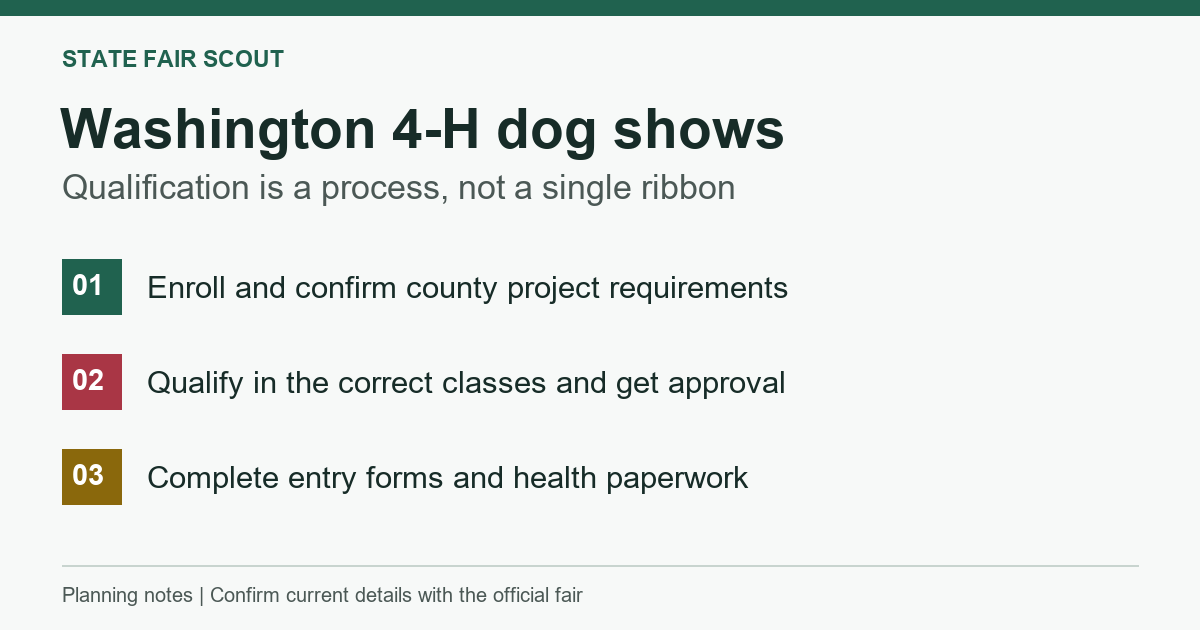
The path to a Washington State 4-H Fair dog show starts with your county dog project, not a general-admission ticket to the fair. Enroll in the right project, meet the care and training requirements, compete in the county’s approved qualifying event, and obtain county approval before completing the state entry. A ribbon can be part of qualification without guaranteeing a place.
This is a planning guide based on official Washington State University Extension resources checked October 3, 2026. The 2026 state fair has finished. Use its rules to understand the process, but confirm the next fair year’s deadlines, class descriptions, allocations, and exhibitor instructions when they are released. Our Washington State Fair visitor guide covers the public visit; this article focuses on the youth exhibition pathway.
1. Choose the Correct Fair Year and Official Resources
Begin at the WSU State 4-H Fair resource page. Keep the applicable fair guide, dog program policies, discipline guides, and exhibitor letters together. Each document answers a different question: program eligibility, the class exercises, qualification, or what happens after an entry is accepted.
A useful preparation folder has four sections: enrollment, the dog’s records, qualifying-event results, and the state entry. Save the document’s year beside its filename. A search result can open an older county fair book even when its footer shows the current year, so look for the actual edition or revision date.
When two official pages appear inconsistent, ask the county Extension office to clarify before relying on either one. The 2026 fair guide, for example, contains some finals dates in its dog-class text that do not align with its main schedule. Do not carry an old date into a new-season calendar. Obtain the assigned date and current instructions through the county and event organizers.
Write down the answer and the document it applies to. A vague note such as “the fair said yes” is difficult to use later. A note identifying the class, dog, fair year, and person who clarified the question gives your family a more dependable record.
2. Confirm Youth Enrollment and County Deadlines
The 2026 dog program policies require enrollment in the dog program. They identify Junior members as ages 8-10, Intermediate as 11-13, and Senior as 14-18, with age determined October 1 of the current 4-H year. Cloverbuds, ages 5-7, are not eligible for competitive or out-of-county activities under that policy.
The 2026-2027 statewide policy describes an October 1-September 30 program year and allows more restrictive enrollment deadlines for projects and events. An open general enrollment window therefore does not prove that a particular dog-show deadline is still open.
Ask your county office or dog-project leader which enrollment date controls your goal, which club or training group to join, and how the county selects its state delegation. Put the actual deadlines on a calendar with reminders early enough to resolve missing information. Do not wait until the qualifying show to discover that enrollment or a project record needed attention earlier.
County-specific examples show why that matters. Clallam County’s published dog-project page lists a May 1 enrollment requirement and its own health instructions. That is an example of local requirements, not a May 1 deadline to impose on every Washington county. Obtain the equivalent instructions for the county in which you are participating.
Before committing to travel, make a small planning worksheet with your county contact. The following questions organize the conversation; they are not an official form or additional eligibility rules:
| Question to Resolve | What to Record |
|---|---|
| Which enrollment deadline applies to this project and event? | The confirmed date, the fair year, and the source of the instruction. |
| Which show counts as the designated qualifying event? | The event name, location, entry deadline, and the classes you intend to enter. |
| How will the county confirm its state delegation? | The contact person, expected notification process, and the next action your family must take. |
| Which dog and class belong on the state entry? | The agreed identifier, class and lot, and the results used to support that choice. |
| Who submits the forms and what counts as acceptance? | The submission responsibility, attachments, deadline, and confirmation you should retain. |
Keep unresolved questions visible rather than filling a blank with a guess. If a deadline has not been announced, record that status and ask where the county will publish it. If two adults share the paperwork, decide who owns each next step. This prevents both adults assuming the other has already sent a form.
A family beginning in autumn can use the worksheet to plan the coming program year, while a returning exhibitor can compare it with last season’s records. Either way, the completed notes should describe this specific youth, dog, county, and fair year. Avoid copying another family’s calendar without checking its assumptions.
3. Establish the Dog’s Project Eligibility
The state dog policies permit purebred and mixed-breed dogs, excluding wolf or coyote hybrids. A member may borrow, rent, or lease a dog with appropriate project documentation. The dog must be under the member’s care and training for at least 60 days before a qualifying show. County programs may be more restrictive.
For a borrowed or shared dog, clarify the arrangement before training begins. Record who handles daily care, where the dog lives, and how practice sessions will work. Ask the leader what documentation is required and whether sharing creates class or age-division conflicts. An informal arrangement should not be left for the entry desk to interpret.
Keep the dog’s name or identifier consistent across the project record, health paperwork, score sheets, and entry. If a family uses a nickname at home and another name in veterinary records, make the connection clear through the approved process. Small mismatches are much easier to sort out before the show than during check-in.
Safety and welfare come before competition. Discuss the dog’s temperament and physical readiness with the leader and veterinarian when appropriate. A dog that enjoys home training may respond differently around crowds, unfamiliar dogs, and long waits. Ask for help early instead of using a qualifying event as the first test of whether the handler can manage the setting.
4. Qualify Through the County, Then Confirm Selection
WSU’s dog policies require qualification at the county fair or designated qualifying event and approval by the county’s 4-H Extension staff. A commercial dog show, unrelated ribbon, or ordinary fair admission does not establish that approval.
For Sub-Novice, Beginner-Novice, Pre-Novice, and Novice, the 2026 state fair guide excludes two red ribbons or a white ribbon in either fitting/showmanship or obedience. Within the county allocation, two blues have priority, followed by blue showmanship/red obedience, then red showmanship/blue obedience. Advanced classes have different qualification thresholds; ask your county to apply the appropriate section.
Think of this as two decisions: whether your results meet the rules, and whether the county confirms your place in its delegation. Keep both showmanship and obedience score sheets. Ask which result applies to which dog and class, especially if the member showed more than one animal.
For example, a family with a qualifying ribbon combination should ask, “Have we been selected in the county allocation, and what entry step comes next?” That question is more useful than assuming the ribbon itself is a state entry. It separates performance from administrative approval without diminishing the achievement.
If a result does not qualify, ask the leader about an appropriate next step in the program. A later event might or might not be designated for qualification. Do not promise a second chance that the county has not approved. Training goals, club activities, and another season can still be valuable outcomes.
5. Match the Entry to the Actual Qualified Class
The 2026 guide requires obedience exhibitors to enter fitting/showmanship, obedience, and herdsmanship. It also requires entry in the most advanced class in which the dog earned a county blue ribbon. Previous state blue ribbons can trigger advancement or movement within the class tier; have the leader check the dog’s record before selecting a class.
Create a one-line entry summary for each dog: handler, age division, dog identifier, qualified discipline, class, qualifying result, and county approval. Use the official class name and number from the applicable guide. A nickname such as “beginner class” is not enough when several novice-level options exist.
Review previous state participation as well as this year’s county score. A handler’s new age division, a dog’s previous ribbon, or a changed class description can affect the entry. Ask questions before clicking a final submission button; do not choose an easier-looking class purely because it fits the day’s schedule.
Herdsmanship is not an optional activity to ignore after the ring performance. Ask the county how duties will be organized and build those commitments into the family’s day. Clarify what the youth will do and where accompanying adults may help without taking over the member’s responsibilities.
6. Prepare Showmanship and Obedience as Separate Skills
Practice Presentation and Knowledge for Showmanship
The March 2026 showmanship guide focuses on the member’s ability to care for and present the dog, including grooming, ring procedure, handling, and knowledge. It is not simply a contest to choose the most attractive purebred animal. The guide also describes five knowledge questions drawn from the designated study material.
Use the score sheet with your leader to choose a few specific goals. One week might focus on an orderly presentation, another on keeping appropriate spacing, and another on explaining basic care. Practice answering in your own words rather than memorizing phrases without understanding them.
Try a calm rehearsal with another person acting as the judge, in a setting approved by your leader. The aim is to learn the sequence and identify questions, not to create a stressful dress rehearsal. Note what felt difficult and bring those observations to the next training session.
Learn the Exercises for Your Obedience Class
The March 2026 obedience guide gives class-specific exercises. Beginner Novice, for example, includes heel on leash, figure eight, sit for examination, sit-stay, and recall, with no group exercises. Other novice classes are not interchangeable merely because their names sound similar.
Keep a simple practice log: the exercise, what went well, and what needs guidance. Ask the trainer how to build skills appropriately for this particular team. A checklist helps you notice gaps, but it does not replace instruction or justify using unsafe equipment.
Prepare the handler as well as the dog. Make sure the youth knows how to approach the ring, listen to directions, and ask a question appropriately. Practice managing paperwork and belongings outside the ring so the actual performance does not begin with a scramble for a number or lead.
7. Treat Agility and Knowledge Contests as Separate Paths
The February 2026 agility guide requires active county dog-project participation and obedience/showmanship participation at a qualifying event. It also states a minimum dog age of 15 months for competition and requires appropriate training. A backyard obstacle experiment is not a substitute for the accepted training pathway.
If agility is your goal, ask the leader about readiness, the approved class, qualifying results, and the entry’s jump-height information. Do not assume obedience selection automatically places the dog in an agility event. Confirm which discipline the entry covers and which additional forms or county approvals apply.
Dog Judging, Dog Bowl, and Skill-a-Thon are also different from exhibiting your dog in obedience. The March 2026 dog-contest resource describes the knowledge-contest pathways. Read the instructions for the actual event rather than transferring a rule about a judging contest to the dog show.
This distinction matters when a notice says an activity does not need county pre-qualification. Such wording may apply to a specific activity, not every dog event at the fair. Tell the county office exactly which competition you mean when asking whether you are eligible.
8. Complete Entry and Health Paperwork Before Traveling
Use the County’s Approved Entry Process
After approval, ask who submits the entry, which documents the family provides, and how receipt is confirmed. Work from the current exhibitor letters, including the dog obedience letter, rather than a previous participant’s recollection. The letters and general exhibitor information cover arrangements that a qualification summary does not.
Save the submitted form, confirmation, and the county contact. Check the handler’s details, dog identity, class and lot, assigned day, and any required attachments. Ask how to correct a mistake instead of submitting a second entry without guidance. Keep a short list of questions until each has a clear answer.
Check Veterinary Records, Not Just a Collar Tag
The 2026 veterinary rules require current veterinarian-issued rabies documentation and flea-free dogs. Confirm the accepted certificate format with the guide and county office. A collar tag alone is not the paperwork plan.
Arrange any veterinary questions early. Keep the approved documents in a clearly labeled folder and a backup copy where permitted. Do not calculate vaccine timing from an unrelated county’s page or repeat a vaccine yourself based on this article. Your veterinarian and current event rules should guide those decisions.
Before departure, check that the paperwork identifies the same dog entered for the show. If a document needs a clinic signature or correction, resolve it before arrival. Ask about any additional county health conditions instead of assuming that meeting one statewide requirement completes every check.
9. Plan the Exhibitor Day Around the Dog’s Needs
Arrival, Care, and Family Logistics
Confirm the assigned check-in time, unloading point, veterinary inspection, parking, passes, benching, and release instructions with the current exhibitor material. A public gate time is not an exhibitor arrival instruction. Keep the unloading plan separate from the public parking information in our Washington fair guide.
Pack the dog’s usual care supplies and the equipment permitted for the discipline. Ask the leader about the complete list rather than buying a new collar or training aid because another dog sport uses it. Include food, water, cleanup materials, and an organized place for the youth’s belongings.
Decide how the adults will support the youth without taking over the project. Plan meals, transport, and any siblings’ activities around the exhibitor’s obligations. A ticket to a public attraction should not conflict with a show class or a duty the county expects the member to complete.
Make a contingency plan for illness, a delayed journey, or a dog that is not coping well. Identify whom to contact and keep the animal’s welfare central. Do not travel with a visibly unwell animal merely because a room or ticket has already been paid for.
10. Keep a Clear Record for the Next Season
Review the Result and the Next Class with Your Leader
After the event, keep the score sheets and note the class, dog, date, and ribbon. Discuss the next appropriate class before another entry. Ask what the result changes, what remains a training goal, and whether next year’s rules introduce a different requirement.
A useful end-of-season review has three parts: one skill the team improved, one practical problem to fix, and one question to take to the county office. Those notes make the next year easier without treating a single ribbon as the whole purpose of the project.
Your final pre-entry check is simple: current project enrollment, eligible dog and care period, approved qualifying results, county selection, correct class, accepted entry, and complete health records. Keep that sequence in order. The county office and WSU’s current documents determine eligibility; this article helps you organize the work needed to ask the right questions and prepare.