Entering a rabbit at the Oregon State Fair starts with choosing the correct competition. Open-class entries and Oregon 4-H participation follow different routes. Before completing a form, decide which program you are entering, locate that program’s current handbook, and confirm the rabbit’s division and class.
Planning status: Checked October 1, 2026. The 2026 competition has finished. The dated examples below explain the process; they are not open registration offers or confirmed 2027 requirements.
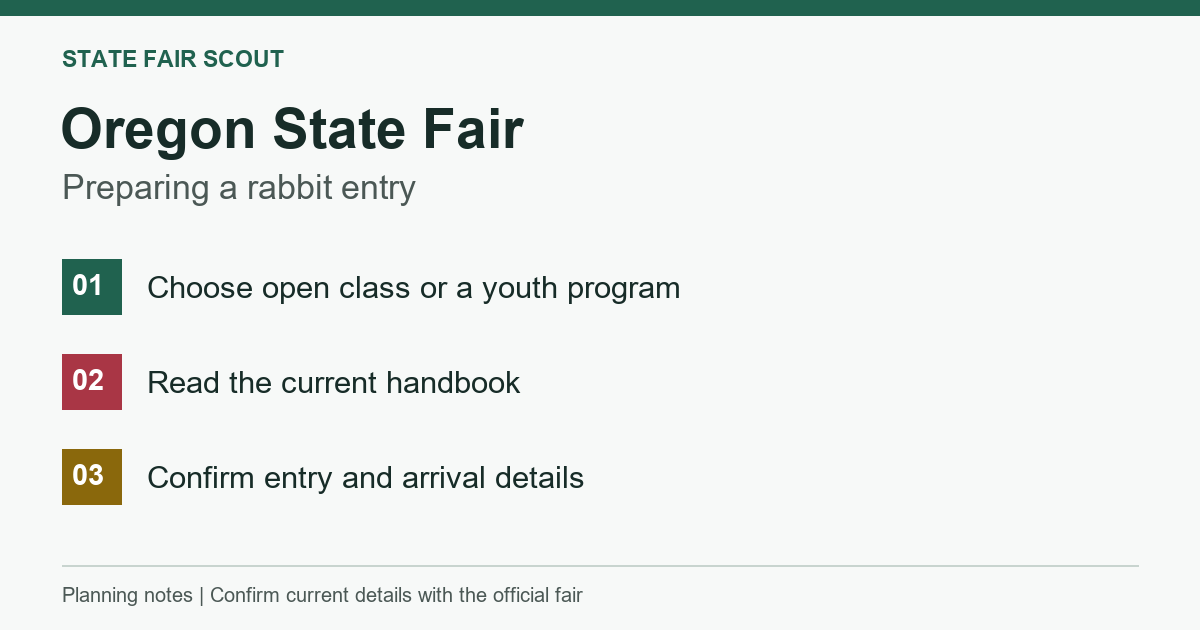
Choose the right entry route
Open-class small animal competition
Start at the fair’s Open Class Animals page and follow the Small Animals handbook link. In the 2026 handbook, open entries did not require a previous county-fair entry or win. Registration and full payment were online, with no late entries allowed.
This is the route to investigate if you are not entering through a youth organization. Do not assume that “open” means there are no age, identification, breed, health, or scheduling requirements. Read the general rules, department rules, and rabbit section together.
Oregon 4-H participation
The OSU Extension State Fair page describes participation for 4-H members ages 12 and up, with qualification determined through county programs. Your county Extension office is the first contact for eligibility, nomination, and registration instructions. A county result is not a reason to independently enter a different open-show form.
Ask your leader which documents and deadlines apply specifically to rabbits. General pages may also discuss cooking contests, presentations, or static exhibits; their time-slot instructions should not be assumed to apply to an animal show. Use the animal-science fairbook and small-animal schedule linked by Extension.
Other youth programs
If you participate in FFA, begin with your adviser and the fair’s FFA information. Do not borrow 4-H class numbers or open-class procedures unless the program explicitly directs you to do so. Write the program name at the top of your notes so that everything you collect stays associated with the right competition.
Check the handbook’s year, not just its link label
Search results can lead to older PDFs, and website menus sometimes retain dates from a previous fair. Open the document itself, check its cover and calendar, and compare the rabbit section with the general schedule. If two official pages disagree, ask the competition office to resolve the conflict before entering.
For reference, the 2026 open-show handbook listed an August 21 entry deadline, September 2 check-in from noon to 7 p.m., September 3 rabbit judging beginning at 9 a.m., and September 7 check-out at 6 p.m. The rabbit entry fee was $3 per entry per class. These are historical details, not next-season deadlines or prices.
Save the handbook you used along with your confirmation. That makes it easier to explain a question by document name and section instead of relying on a screenshot with no year visible. Check for revisions again before travel.
Make a worksheet for each rabbit
Prepare the information before opening registration. A separate row for every animal reduces the chance of assigning one rabbit’s details to another. Use the spelling and identification that you can consistently match across your records, carrier labels, and entry confirmation.
- Exhibitor name and the correct youth or open program.
- Rabbit identification and any required permanent marking.
- Breed, variety, sex, and birth date or age information.
- Division number and class number from the relevant handbook.
- Any additional class or showmanship entry that you intend to make.
- Questions that need an answer before submitting payment.
The 2026 open department required permanent markings in the left ear and warned that incorrect division or class information could affect eligibility. It also requested breed, variety, age, and sex information for rabbit entries. Consult the current handbook for exact requirements rather than treating this article as the class list.
If a breed name, variety, or age class is unclear, send the superintendent a focused question. Include the program and handbook section you are using. Do not guess a similar-looking class simply to get through a required field.
Resolve eligibility and health questions early
Ask the show office what documentation is needed for your animal and origin, then discuss animal-health preparations with your veterinarian. Health requirements, movement rules, and disease precautions can change. This article does not supply a vaccination schedule or replace veterinary advice.
Useful questions include whether any current disease-related restrictions apply, how the arrival health check works, what identification staff will compare, and whom to contact if the animal becomes unwell before departure. Keep those answers with your registration records.
Plan for the possibility of not showing. If there is a concern about the rabbit’s condition or ability to travel, consult your veterinarian and the superintendent rather than allowing a paid entry to determine the decision. Ask about withdrawal and notification procedures before an urgent situation develops.
Submit the entry carefully and save the receipt
Follow the registration link from the current official competition page or handbook. Check that the event name, year, and department match your intended entry. An old bookmarked registration page can look familiar while referring to the wrong event.
Work through the registration in two passes. First enter the exhibitor and animal information. Then compare every field with your worksheet before paying. In particular, check that the account holder and exhibitor are not accidentally reversed when a parent is assisting a child.
- Confirm the selected program and year.
- Check every animal’s identification, division, and class.
- Review the fee total and all terms before submission.
- Save the completed-entry confirmation and payment receipt.
- Record the office contact and any correction procedure.
A started account or saved shopping cart is not proof that an entry was accepted. If you cannot find a completed confirmation, contact the office with your reference information. Do not repeatedly submit payment in an attempt to fix an uncertain status.
Arrange transport, arrival, and collection as one plan
Competition check-in is a different process from arriving as a fair visitor. Confirm the exhibitor entrance, unloading instructions, parking arrangements, credentials, and the date when the animal must leave. Our Oregon State Fair visitor guide helps with general travel, but the department’s instructions govern animal arrival.
Build a schedule that includes loading at home, travel, check-in, and time to speak with staff if an entry needs clarification. Save the superintendent’s contact offline. Ask where carriers should go after unloading and whether the department supplies any of the equipment or routine care you expected to bring.
For a young exhibitor, decide who is responsible for transportation, supervision, paperwork, and communication with staff. The OSU Extension page also explains official-chaperone expectations for 4-H participants. Confirm these through your county program rather than booking accommodation first and trying to fit the requirements afterward.
Do not assume that finishing judging means the animal can leave immediately. Check release arrangements as carefully as the arrival time. A multi-day exhibit can require a different family schedule from a one-day show.
Prepare for the experience, not just the form
Ask your program leader or an experienced mentor how the specific show operates. For youth showmanship, use the current evaluation sheet or program materials to understand the skills being assessed. A rabbit’s conformation class and the exhibitor’s handling evaluation are different activities, so make sure you know which you entered.
Practice the practical sequence with an appropriate mentor: reading the entry information, recognizing the correct identification, following staff directions, and knowing what to do when the class is called. Use welfare-conscious handling guidance from your veterinarian or youth program. Avoid attempting unfamiliar procedures on the day of travel.
Make a small document folder rather than carrying an unorganized stack. Include confirmations, the relevant handbook sections, requested health documents, contact details, and your own animal list. Carry only the personal information needed for the event, and do not display private documents on a cage or carrier.
Keep the family budget realistic
An entry fee is only one part of the cost. Budget separately for transport, accommodation if needed, food, supplies, parking, and admission or credentials for accompanying people. Ask exactly what is included in your competition entry before buying additional tickets.
If the trip also includes a recreational fair visit, put animal-care and show commitments into the calendar first. Schedule optional rides and food stops around those commitments. Our family planning guide can help make the non-competition parts of the day manageable.
After the show, keep the result sheet and notes about what you would change next time. Record which questions were hardest to answer, what travel timing worked, and which supplies were useful. Those practical records are more helpful for a future entry than copying last year’s dates onto a new calendar.
Frequently asked questions
Does my rabbit need to win at a county fair first?
The 2026 open-show rules did not require a county-fair entry or win. The 4-H route is different and uses county qualification. Confirm the rules for the program you are entering.
Can I enter using last year’s class number?
Use it only after checking it against the current handbook. Keep a separate record of the current program, division, and class so an old number is not carried forward by accident.
Is registration for the next fair already open?
This guide does not confirm an open 2027 registration window. Start at the official Open Class Animals page or OSU Extension, depending on your program, and use the newly issued instructions.
Can I simply bring a rabbit to the grounds?
No. Arrange participation through the appropriate competition process and obtain the required confirmation and arrival instructions. A visitor ticket is not a competition entry.
Where should I ask about a form or eligibility problem?
For open class, use the superintendent or agricultural-program contact in the current handbook. For 4-H, contact your county Extension program. Send a concise description with the event year and entry reference, without including unnecessary private information.