The Illinois State Fair’s biggest concert posters do not show every opportunity to hear live music. Free entertainment stages give you another way to build a music-focused visit, especially if you want to sample several performers rather than buy a separate ticket for a headline show. The key is to check the stage and admission terms together.
This guide covers the Illinois State Fair in Springfield. Sources were reviewed October 2, 2026, after the 2026 fair ended. Next-season performers and prices should be confirmed when announced; a past lineup is not a new booking. Our Illinois fair visitor guide provides the broader trip overview.
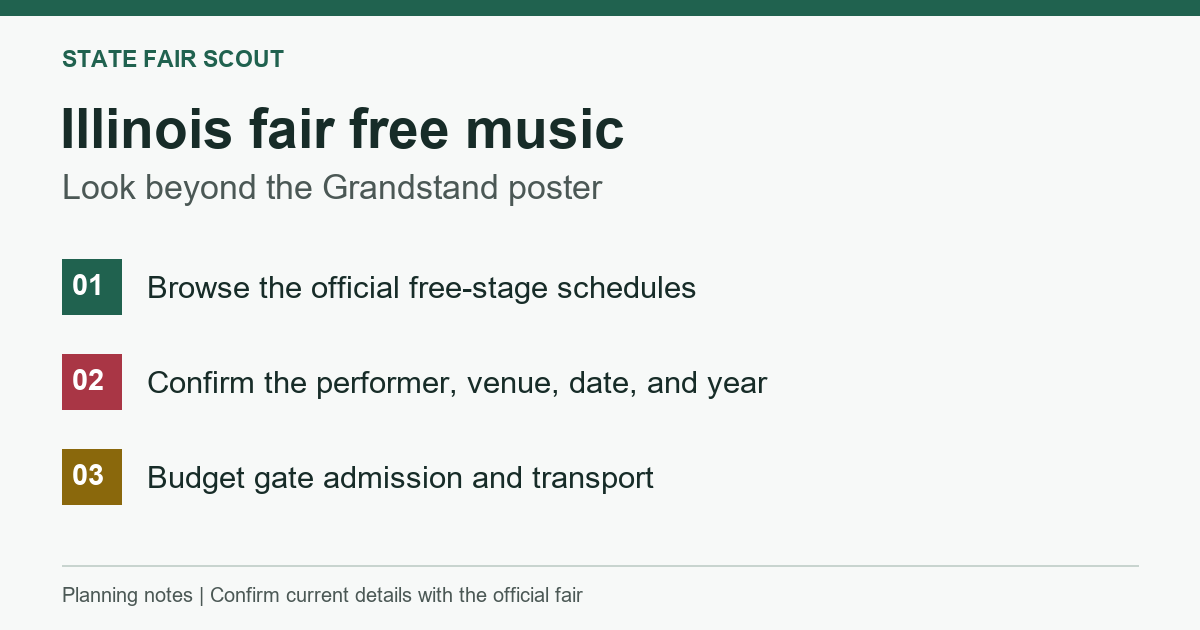
Find the free stages and check the right schedule
Start with the official free-entertainment index
Open the official free entertainment stages page and select a stage or area for its schedule. This is a more useful starting point than assuming the Grandstand is the fair’s only music venue. The fair’s broader entertainment directory separates the Grandstand, free stages, arena, and other programming.
Read descriptions carefully. “Free entertainment” can include contests, demonstrations, and nonmusical shows as well as bands. To build a live-music plan, record the named performer, stage, date, and start time rather than saving an entire mixed-activity calendar.
Check Grand Central Stage under the Reisch Pavilion
The official Grand Central Stage page describes a free concert series under the Reisch Pavilion, with entertainment throughout the day and nightly spotlight artists. Its address still includes “risingstar,” but the page itself identifies Grand Central; use the venue name shown in the current content.
At review time its schedule table had no matching events. That is not evidence that music has permanently stopped. It means you should wait for the season’s listings rather than insert last year’s artists into a future itinerary. Save the stage page and check again as the fair publishes its program.
Cross-check the daily schedule and year
Use the daily schedule page to organize your selected date. Compare each music entry with the individual stage page. If one source is clearly from a previous season, do not blend the two into a seemingly current schedule.
Save a small list: one full set you most want to hear and two optional shorter stops. Include the date in the saved note so you do not accidentally use Friday’s schedule on Saturday. If the fair changes an event, the original screenshot should be treated as a reference, not as the final operating instruction.
Do not assume every Grandstand show has the same terms
The Grandstand page explains that fair admission is not included with a Grandstand concert ticket. Read both the concert listing and gate-admission terms before purchasing. An included free-stage performance and a separately ticketed Grandstand show require different budgets.
There can also be explicitly announced exceptions. An official August 2026 release advertised a free Grandstand concert featuring 38 Special and Warrant on August 17. That was a specific past event, not a rule that all Grandstand concerts are free or a promise that the offer will return.
Build an affordable day around the music
Budget for getting into the fair
A free performance does not make parking, gate admission, meals, or midway rides free. List those costs separately before choosing the date. Check any current admission promotion for eligibility and deadlines; a theme-day discount may apply to only some members of your group.
If the main purpose is hearing music, decide whether rides or another paid show are optional. This keeps a low-cost entertainment plan from turning into an expensive day by accident. Our fair ticket guide offers a useful framework for comparing admission and add-ons without assuming this year’s prices.
Make a route, not a race
Place the priority performance first on your plan. Choose nearby food and an exhibit before it, then leave an optional second stage for afterward. Do not pack every advertised start into a schedule without considering the walk between locations and the time needed to leave a crowd.
For families, a short music stop can be a good test of everyone’s energy before committing to a full evening. Agree on a meeting point away from the busiest walkway. A smaller plan completed comfortably is more useful than a long list that leaves someone hungry or tired before the favorite act begins.
Confirm seating and accessibility for the actual stage
Review the official services information and contact the fair about the venue you intend to use. Ask about accessible viewing, companion arrangements, seating, and the route from your entry point. Do not assume an accommodation described for the Grandstand is automatically offered at every free stage.
Likewise, verify chair and bag rules before carrying extra equipment. If anyone needs frequent breaks or prefers more room around them, make that part of the viewing decision. Leave room in the itinerary for an early departure rather than treating a complete set as mandatory.
Check weather and current announcements
Outdoor programming can be affected by weather, so recheck the official event information before leaving home and follow staff announcements on site. A pavilion roof should not be treated as a universal answer to severe weather; ask staff where to go if safety instructions are issued.
Keep your return route and parking reference available. Our state fair concert planning guide can help you compare music formats across fairs, but Illinois’s current stage listing and rules should control the details of this visit.
Free music questions
Where should I look first?
Use the official free entertainment stages index, then the schedule for the specific stage. Grand Central is a particularly useful music starting point, but verify the date and artist before making plans.
Does an empty schedule mean there will be no concerts?
No. An empty table is not a confirmed cancellation or a finished future lineup. Check for announcements as the next fair approaches instead of filling the gap with old performers.
Are all Grandstand performances free?
No. Read the individual event terms. The fair has announced particular free Grandstand events in the past, while its normal concert-ticket information distinguishes those purchases from gate admission.
Before you go: save the correct year’s schedule, confirm your priority set, budget admission and transportation, and agree on a flexible route. You can enjoy a music-led day without assuming that every stage, ticket, and annual promotion works the same way.